Post Build Cleaning for Commercial Handover
A completed project is not necessarily a ready-to-use workplace. Fine construction dust can settle in ceiling voids, on ventilation grilles, inside joinery and across IT areas long after the principal works appear finished. Post build cleaning provides the detailed final stage that prepares commercial premises for a safe, professional and operational handover.
For facilities managers, property managers and project teams, this is not a cosmetic exercise. It is the point at which a newly built, refurbished or altered space becomes ready for employees, visitors, equipment installation and day-to-day business activity. A well-planned clean protects the standard of the build, supports health and safety responsibilities, and prevents avoidable delays at a critical time.
Why post build cleaning needs specialist planning
Construction and refurbishment create a particular type of cleaning challenge. There may be plaster dust, paint residues, adhesive marks, grout haze, packaging, protective films and trade waste, often across multiple surfaces with different care requirements. Glass, natural stone, polished floors, fitted furniture, washrooms and specialist equipment all need the right treatment.
Using an unsuitable chemical or abrasive pad can permanently damage a newly installed finish. Equally, a rushed clean may leave dust in air vents, drawers, cable trays or under raised flooring, where it can later affect presentation, air quality or equipment performance. The work therefore needs more than extra labour. It needs experienced operatives, appropriate machinery, documented methods and supervision.
The scope also depends on the stage of the project. A site may require an initial builders’ clean while trades are still completing work, followed by a detailed sparkle clean immediately before handover. In other cases, a phased approach is more practical, allowing completed floors or zones to be released progressively while construction continues elsewhere.
What a commercial post build clean should cover
A specification should reflect the building, its finishes and the intended use of each area. Offices, reception spaces, meeting rooms, kitchens, washrooms, stairwells and communal areas all have different priorities. Server rooms, laboratories, healthcare-adjacent environments and high-specification corporate interiors may require additional controls.
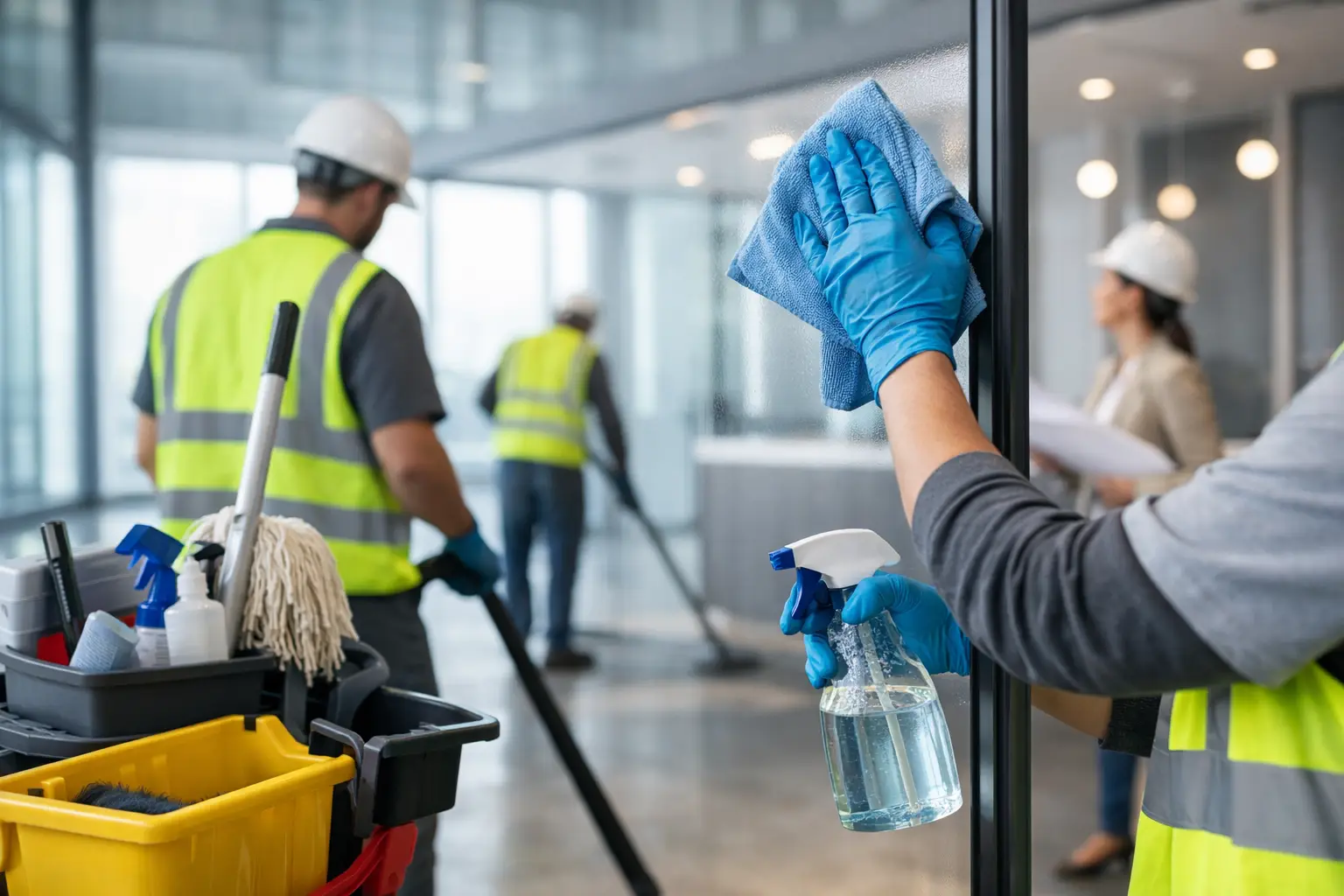
A thorough programme typically starts with the removal of non-hazardous construction debris and packaging, subject to the agreed waste arrangements. Operatives then work through detailed dust removal from high-level surfaces, ledges, fixtures, fittings, skirting, internal glazing, frames and joinery. Vacuuming with suitable filtration is particularly important, as dry dusting alone can simply move fine particles around the space.
Hard floors require close attention. Cement residues, paint splashes and adhesive traces should be assessed before removal, as the correct method differs between vinyl, stone, timber, tiles and safety flooring. Carpeted areas may need a post-installation vacuum and, where appropriate, professional carpet cleaning to remove tracked-in dirt and fine debris.
Final detailing makes the difference at handover. This includes cleaning switches, sockets, doors, handles, sanitary fittings, kitchen units, internal glass and accessible ventilation grilles. Protective films should only be removed where agreed, particularly when further trades, furniture deliveries or inspections are still planned.
Safety, compliance and site control
A post build cleaning contractor becomes part of the site operation, even if only for a short project. That requires clear coordination with the principal contractor, site manager and facilities representative. Access arrangements, work zones, delivery times, welfare facilities, security requirements and emergency procedures should be agreed before cleaning begins.
Risk assessments and method statements should address the actual site conditions rather than rely on a generic template. These may include working around unfinished areas, wet-floor controls, manual handling, access equipment, dust exposure and the safe use of cleaning products. COSHH information is essential where chemicals are used, particularly when removing residues from newly fitted surfaces.
The handover date can create pressure, but speed should not come at the expense of safety or quality. A reliable provider will identify restrictions early, such as incomplete snagging, trades still working in an area, unavailable water supplies or floors that have not yet cured. Raising these issues promptly gives the project team choices, rather than leaving problems to the final day.
The value of a phased cleaning programme
The most effective projects are planned before the final week. Early involvement allows cleaning requirements to be built into the handover programme, with sufficient time for each stage and for a final inspection. It also makes it easier to determine where cleaning teams can work without disrupting other contractors.
For a larger office fit-out or multi-floor refurbishment, phased cleaning is often the sensible option. Initial cleaning can take place once major building work is complete in a zone. A further detailed clean can then follow after furniture installation, IT commissioning and final snagging. This reduces the risk of cleaned areas being re-contaminated and gives the facilities team greater control over readiness.
There is a trade-off. A single final clean may appear simpler to arrange, but it can become inefficient if dust and debris have accumulated throughout the project or if access is limited. Phased work requires coordination, yet usually supports a more consistent finish and fewer last-minute surprises.
Quality control at the point of handover
Commercial handover is judged in the details. A reception desk may be pristine, but dusty window frames, marked internal glass or debris behind doors will still affect the first impression. More importantly, an incomplete clean can lead to disputes between contractors, delayed occupation or additional work for an already stretched facilities team.
A clear inspection process should be agreed as part of the cleaning plan. This can include area-by-area checks against the specification, identified snag items, photographic records where required and a sign-off route for the client or project representative. Quality control is especially valuable where several contractors are involved, because it creates accountability and prevents uncertainty about what has been completed.
The cleaning team should also be able to respond flexibly if the programme changes. Construction schedules do move. A dependable commercial partner will communicate clearly about what can be achieved, what needs to be rebooked and how the revised work will affect the handover plan.
Preparing the premises for occupation
The final clean should support the next operational step, not simply mark the end of construction. Before occupation, facilities teams should consider whether the building also needs ongoing office cleaning, washroom servicing, consumable supplies, window cleaning or hard-floor maintenance. Setting these services in place early avoids a gap between handover and the first working week.
It is also worth confirming responsibility for areas that are easily missed: plant-adjacent spaces, storage rooms, risers, external entrances, lift interiors and post-installation waste from furniture or technology suppliers. A final walk-through with the cleaning specification in hand is more effective than relying on assumptions.
EDM Cleaning provides tailored post build cleaning programmes for commercial premises across London and the South East, with trained operatives, appropriate equipment and quality checks designed around each site. The aim is straightforward: to make the transition from construction site to working environment easier to manage.
A professional finish gives employees confidence in their new surroundings and reassures visitors from the moment they arrive. More than that, it gives the facilities team a cleaner, safer starting point from which to keep the building operating at the standard the organisation expects.