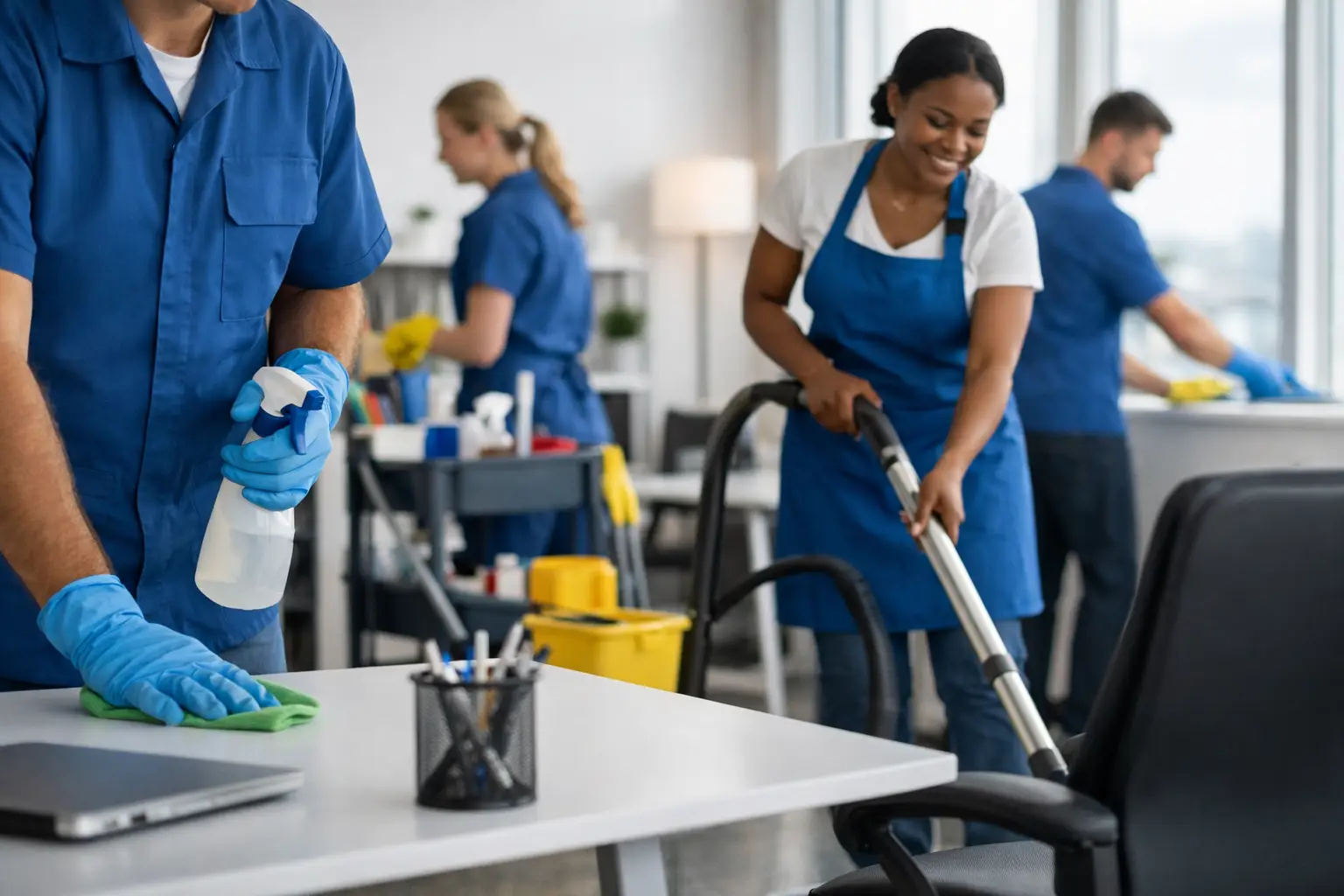
Why Outsource Workplace Cleaning for Your Office?
A workplace can look presentable at 9am and still be carrying the evidence of a poor cleaning operation: missed touchpoints, tired carpets, overflowing washrooms, dusty equipment and meeting rooms that are not ready for visitors. For facilities and operations teams, the question is not simply whether the premises are cleaned. It is why outsource workplace cleaning when standards, accountability and business continuity are on the line.
An outsourced commercial cleaning partner brings a managed service to an area of facilities management that can otherwise absorb a disproportionate amount of time. Rather than coordinating rotas, sourcing products, replacing absent staff and responding to recurring issues internally, your team can work with a specialist supplier responsible for delivering an agreed standard.
Why outsource workplace cleaning rather than manage it in-house?
In-house cleaning can work for some organisations, particularly where a small site has modest requirements and a manager has the capacity to oversee the service closely. However, it also makes the organisation responsible for recruitment, training, supervision, holiday and sickness cover, equipment, consumables, health and safety processes, and quality checks.
That responsibility becomes more demanding in busy London workplaces. Building occupancy changes through the week, client meetings arise at short notice, and different areas of the premises require different levels of care. An office kitchen, washroom, reception, boardroom and server room should not all be approached in the same way.
Outsourcing does not mean giving up control. A well-structured contract should give facilities managers more useful control: a tailored specification, defined frequencies, clear reporting routes, scheduled reviews and a named point of contact. The supplier takes ownership of service delivery, while the client retains visibility of the outcomes that matter.
A reliable workforce without the daily administration
Cleaning quality is closely tied to the people carrying out the work. Operatives who understand the site, have been trained in the right methods and are properly supported are more likely to notice detail, follow procedures and take pride in the finished environment.
With an outsourced provider, responsibility for recruiting, vetting, training and managing cleaners sits with the specialist. This includes arranging cover when an operative is unavailable, so the workplace is not left without support because of a single absence. For an office manager or facilities manager, that can remove a regular source of last-minute disruption.
Continuity still matters. The best arrangements do not rely on a constantly changing team. They balance dependable site-based operatives with supervisory support and properly briefed cover staff who can step in when needed. That approach protects the familiarity that helps cleaning teams work efficiently, without creating a single point of failure.
Standards that are planned, checked and improved
A cleaning specification is more than a list of tasks. It should reflect how the building is used, when it is occupied and which areas carry the greatest hygiene, presentation or operational risk. Reception areas may require visible daytime attention. Washrooms need regular replenishment and checks. High-traffic hard floors may need planned maintenance, while carpets benefit from periodic deep cleaning before appearance deteriorates.
An outsourced workplace cleaning provider can build these requirements into a programme rather than treating them as reactive requests. Daily office cleaning can sit alongside periodic window cleaning, carpet care, hard-floor maintenance, deep cleaning and washroom services. Specialist work is planned around the main contract and site activity, helping to prevent avoidable deterioration.
Formal quality control is equally valuable. Spot checks, supervisor visits, service reviews and clear escalation processes make it easier to identify issues early. If standards slip in one area, the answer should be more than a quick apology. It should be a documented correction, followed by checks that show the issue has been resolved.
Better hygiene and safer working practices
Workplace hygiene affects employee confidence as well as the appearance of the building. Shared kitchens, washrooms, meeting rooms and touchpoints are used by many people every day. A consistent cleaning programme helps maintain a setting where staff can work comfortably and visitors can be received with confidence.
Specialist providers also bring knowledge that should not be assumed within an internal team. This includes correct chemical handling, COSHH procedures, safe working methods, colour-coded equipment where appropriate and the safe use of machinery. In sensitive areas, such as computer suites and server rooms, the wrong cleaning method can create operational risk. These environments require a controlled approach that avoids introducing moisture, dust or disruption around essential equipment.
For organisations with particular hygiene requirements, additional services such as electrostatic disinfection can be incorporated where appropriate. The right response depends on the site, its occupancy and the task at hand. It should support a considered cleaning plan, not replace routine cleaning fundamentals.
The right equipment for the task
Commercial premises often need more than vacuuming and surface wiping. Entrances collect grit and moisture, carpets hold soil, hard floors lose their finish over time, and glass can quickly affect the impression a workplace makes. Attempting specialist maintenance with unsuitable equipment or products can damage surfaces or produce inconsistent results.
Outsourced cleaning gives organisations access to professional equipment and trained operatives without having to manage the selection, maintenance and replacement of those assets themselves. It also means the cleaning programme can respond to the material and condition of each surface – from stone flooring to upholstery, internal glass and IT equipment.
Environmental considerations should form part of these decisions. Responsible product selection, controlled chemical use, efficient equipment and sensible waste practices can reduce unnecessary environmental impact while maintaining the standards expected in a professional workplace. This is particularly relevant for organisations seeking to align facilities services with wider environmental management objectives.
Flexibility when the workplace changes
Workplace requirements are rarely static. An office move, refurbishment, increased occupancy, event, seasonal weather or change in working patterns can all affect cleaning needs. A fixed, one-size-fits-all arrangement can leave teams either under-supported or trying to organise extra services at short notice.
A commercial cleaning partner should be able to adjust the service around the operation of the building. That may mean changing cleaning times to suit hybrid working, increasing attention to visitor areas during a busy period, arranging post-build cleaning before a handover or scheduling a deep clean outside normal hours. The purpose is not to add complexity. It is to keep the premises ready for the next working day.
This flexibility is particularly useful across Central London, where access arrangements, building management rules and busy shared environments can shape how and when work is carried out. A provider accustomed to commercial sites will plan around those practical constraints rather than treating them as an afterthought.
Accountability that supports facilities management
The strongest reason to outsource is not that cleaning disappears from a facilities manager’s responsibilities. It is that the responsibility becomes more manageable. Instead of personally resolving staffing gaps, chasing supplies and repeatedly inspecting the same missed areas, managers have a service partner with agreed obligations and a clear route for action.
That partnership should be based on communication, not assumption. The cleaning provider needs to understand the building, its users and the priorities of the organisation. In return, the client should receive straightforward updates, responsive support and evidence that standards are being monitored.
For businesses with several services under one roof, there is an additional benefit in coordinating routine cleaning with specialist requirements. A provider able to support office cleaning, washrooms, janitorial supplies, floor care, IT cleaning and project work can reduce the number of separate service relationships that facilities teams need to oversee.
Choosing an outsourced cleaning partner
Outsourcing succeeds when the provider is selected for more than its task list. Look for a clear approach to staff training, supervision, health and safety, quality assurance and environmental responsibility. Relevant management standards and accreditations can provide assurance, but they should be reflected in day-to-day behaviour on site.
Ask how the supplier will learn the building, manage absence cover, inspect standards and deal with urgent requests. Consider whether the proposed service genuinely reflects your premises or could have been sent to any office. A tailored plan is usually a better sign of long-term service quality than a generic promise.
EDM Cleaning approaches commercial cleaning as an operational investment: dependable people, defined standards and flexible support that helps facilities teams keep their workplaces prepared. The most effective outsourced service should quietly make the working day easier, leaving employees and visitors to notice the workplace for the right reasons.