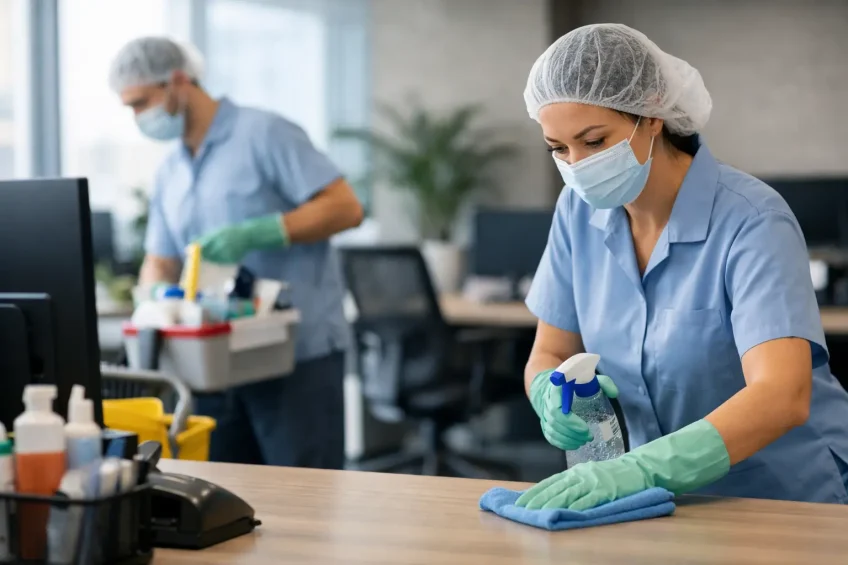
COSHH Compliant Cleaning Services for Offices
A cleaning cupboard can contain products that support a safe, well-presented workplace, but they can also create avoidable risk when they are poorly selected, stored or used. COSHH compliant cleaning services give facilities teams confidence that chemical products and cleaning tasks are being managed properly, protecting operatives, employees, visitors and the building itself.
For offices and commercial premises, COSHH compliance is not a paperwork exercise completed at the start of a contract. It is an active part of service delivery. It affects the products brought on site, the training given to operatives, where materials are kept, how spills are handled and how cleaning work is monitored over time.
What COSHH compliance means in commercial cleaning
COSHH stands for the Control of Substances Hazardous to Health. The regulations require employers to assess and control exposure to substances that may harm health. In a commercial cleaning setting, this commonly includes detergents, disinfectants, descalers, bleach-based products, solvents, aerosols and specialist treatments used for flooring, stone or post-build cleaning.
The aim is not necessarily to remove every chemical from a cleaning operation. Many products remain necessary to achieve the required hygienic result, particularly in washrooms, kitchens, high-touch areas and sites with specific infection-control requirements. The duty is to understand the risk, select suitable controls and ensure those controls work in practice.
A capable cleaning provider should take responsibility for the substances its team introduces to your premises. That includes maintaining current safety data sheets, completing task-specific COSHH assessments and ensuring operatives understand the products and procedures relevant to their work.
Why COSHH compliant cleaning services matter to facilities teams
Facilities managers are often balancing building presentation, employee experience, contractor oversight and business continuity at once. A chemical incident, however minor, can quickly create disruption: an area may need to be isolated, an employee may report irritation or a client may ask for evidence that controls were in place.
Good compliance reduces that exposure. It gives the cleaning team clear instructions on dilution, contact time, personal protective equipment and safe application. It also avoids common causes of failure, such as decanting chemicals into unlabelled bottles, mixing incompatible products or leaving cleaning materials accessible in shared areas.
There is a broader operational benefit too. When chemical management is structured, standards are more consistent. The right product is used for the right surface, reducing the risk of damaged stone, discoloured carpets, dulled hard floors or corrosion around washroom fittings. This matters in corporate offices where appearance and asset protection are part of the workplace standard.
The controls that should be visible on site
A compliant service should not depend on a facilities manager chasing documents or checking every cleaner’s routine. The provider should make controls practical, accessible and auditable.
Site-specific risk assessments
A generic assessment is a starting point, not a finished solution. Each building has different layouts, storage arrangements, ventilation, occupancy patterns and sensitive spaces. A busy City office with shared washrooms requires a different approach from a server room, a newly handed-over development or a client-facing headquarters in the West End.
The assessment should cover the product, who may be exposed, the task being carried out, potential routes of exposure and the measures used to control the risk. It should also account for changes. Introducing electrostatic disinfection, undertaking a deep clean or treating a specialist floor can require an additional review before work begins.
Clear product information and labelling
Safety data sheets provide the technical information behind safe use, including hazards, first-aid actions, storage requirements and disposal guidance. Operatives need access to the relevant information, but they also need concise, usable instructions for their day-to-day tasks.
Every container should be labelled clearly. Where a product is diluted for operational use, the secondary container must identify its contents and hazards. This simple discipline prevents dangerous assumptions and makes it easier for supervisors or emergency responders to act appropriately.
Training that goes beyond induction
Cleaning operatives need training before using hazardous substances, particularly where products require dilution, controlled application or specific protective equipment. However, a one-off induction is not enough. Refresher training, toolbox talks and supervisory checks help keep procedures current and address changes to products or site conditions.
Training should cover more than what to use. Teams should know what not to do: never mix chemicals unless a manufacturer’s instructions specifically permit it, never use food or drink containers for storage, and never improvise when a product label is damaged or a spill occurs.
Safe storage and practical access control
Chemical storage should be secure, orderly and suitable for the products held. Incompatibilities must be considered, alongside ventilation, spill containment and access for authorised operatives. A locked cupboard alone does not guarantee compliance if stock is poorly labelled, excessive quantities are retained or materials are stored beside unsuitable items.
For multi-tenant or high-footfall premises, secure storage is particularly important. It protects employees and visitors while ensuring cleaning teams can start work efficiently without transporting unnecessary products through occupied areas.
Choosing products without compromising the clean
Facilities teams are increasingly looking for lower-impact products and reduced chemical use. This is a positive direction, but product selection needs to be based on performance as well as environmental considerations. A product that is less hazardous but cannot achieve the required cleaning or disinfection outcome may lead to repeated application, inconsistent hygiene or the use of stronger alternatives later.
The best approach is proportionate. Routine office cleaning may use products with a lower hazard profile where appropriate, while specialist tasks may call for carefully controlled treatments. Microfibre systems, controlled dosing equipment and colour-coded materials can also reduce chemical consumption and cross-contamination without lowering standards.
A provider should be able to explain why a product has been selected for a particular task, what controls are in place and whether there is a suitable alternative. This is especially relevant for organisations with environmental objectives, employees with sensitivities or premium finishes that need specialist care.
Documentation is useful only when it supports action
COSHH files, safety data sheets and assessments are essential evidence, but they should be part of a working management system rather than documents that sit unopened in a folder. Supervisors need to know when to review assessments, how to record incidents and when to escalate concerns. Clients need straightforward access to the information relevant to their site.
This is where formal quality and health-and-safety systems add value. ISO 9001 supports consistent service processes, ISO 14001 helps manage environmental responsibilities, and ISO 45001 provides a structured approach to occupational health and safety. Together, they help turn obligations into repeatable controls that can be checked and improved.
At EDM Cleaning, this approach is built into tailored commercial cleaning plans. The service begins with understanding the premises and the required outcome, then matching trained operatives, appropriate equipment and documented procedures to the site. Regular quality control helps ensure agreed standards continue after mobilisation, not just during the first few weeks.
Questions to ask your cleaning provider
Before appointing or reviewing a contractor, ask how COSHH assessments are tailored to your building, how frequently product information is reviewed and how operatives are trained on site-specific procedures. It is also sensible to ask who manages chemical stock, how dilution is controlled and what happens if a spill or exposure incident occurs.
The answers should be clear and operational. A dependable provider will be able to show how its processes work during an ordinary shift, not simply confirm that a policy exists. If your building includes specialist areas such as comms rooms, kitchens, gyms or public-facing reception spaces, make sure these are included in the conversation.
Compliance that supports a ready workplace
The strongest cleaning partnerships make compliance feel routine because the system behind it is well managed. Products are appropriate, operatives are prepared, records are current and issues are dealt with before they become disruptions. That leaves facilities teams with more time to focus on the wider running of the workplace.
A review of your current cleaning plan is a useful place to start. Check whether chemical controls reflect the way your premises are actually used today, particularly after refurbishments, changes in occupancy or the introduction of specialist cleaning tasks. A plan that is current, understood and consistently followed is one of the most practical safeguards a workplace can have.